General information
How to get there?
Order forms
Information about the ATP Agreement
FAQ
Accreditation
Contact information for ATP inspectors
General information about Polish ATP Testing Station at COCH.
Our services include comprehensive testing for ATP certification (renewal, transcription).
To access the order forms scroll below.
Accredited testing in accordance with the ATP Agreement
-Heat-insulated means of motor transport for transporting perishable foods;
– Isothermal containers for road, rail and sea transport of cargo, which allow transshipment between the above-mentioned different modes of transport;
– Insulated means of transport for temperature-sensitive goods – containers.
We perform temperature distribution testing, GDP mapping, DPD mapping, as well as issue ATP, FRC, FNA, GDP certificates, and perform periodic inspections of isothermal bodies to renew ATP (FRC, FNA, GDP, DPD) certificates.
Are the tests performed covered by accreditation?
ATP testing is covered by the accreditation of the Polish Accreditation Center No. AB 308, and a license to use the ILAC MRA international mark of mutual recognition of test reports issued by accredited laboratories around the world.
Where are the tests performed?
Tests are conducted at COCH’s headquarters in Krakow – Juliusza Lea 116, 30-133 Krakow, as well as at the client’s site at the address indicated.
Istnieje możliwość przeprowadzenia badań przez pracowników COCH w Międzyrzecu Podlaskim.
The scope of the facilities surveyed in accordance with the ATP Agreement
Under PCA accreditation, we perform:
+ Reviews that are the basis for ATP certification,
+ measurements of the global heat transfer coefficient “K” for new measure
+ refrigerated transport as well as those in operation that are the basis for ATP certification,
+ We perform full testing of mechanically cooled (refrigerated trailer, refrigerated car, refrigerated trailer, etc.) and non-mechanically cooled (refrigerated car) means of transport;
+ testing the useful cooling capacity of the chiller,
+ Measurements of the global heat transfer coefficient “K” for liquid food tank cars.
Other research (not covered by PCA accreditation):
+ Measurement of the efficiency of thermal equipment of refrigerated transport at the special request of the customer there is the possibility of testing with a thermal imaging camera,
+ leakage checks of the chiller’s refrigeration system, with the issuance of a certificate,
+ checking the indications of thermographs with the issuance of a certificate,
+ installation and sale of thermographs,
+ Thermal imaging of heat loss in insulated bodies.
Directions to
The ATP testing station in Kraków.
How to get there?


Details of the ATP Agreement
Read more about the details of the ATP Agreement and related regulations. Select the appropriate tile to go to the subpage.

ATP Agreement
Discussion and records

ATP plaque
ATP plate pattern and explanations
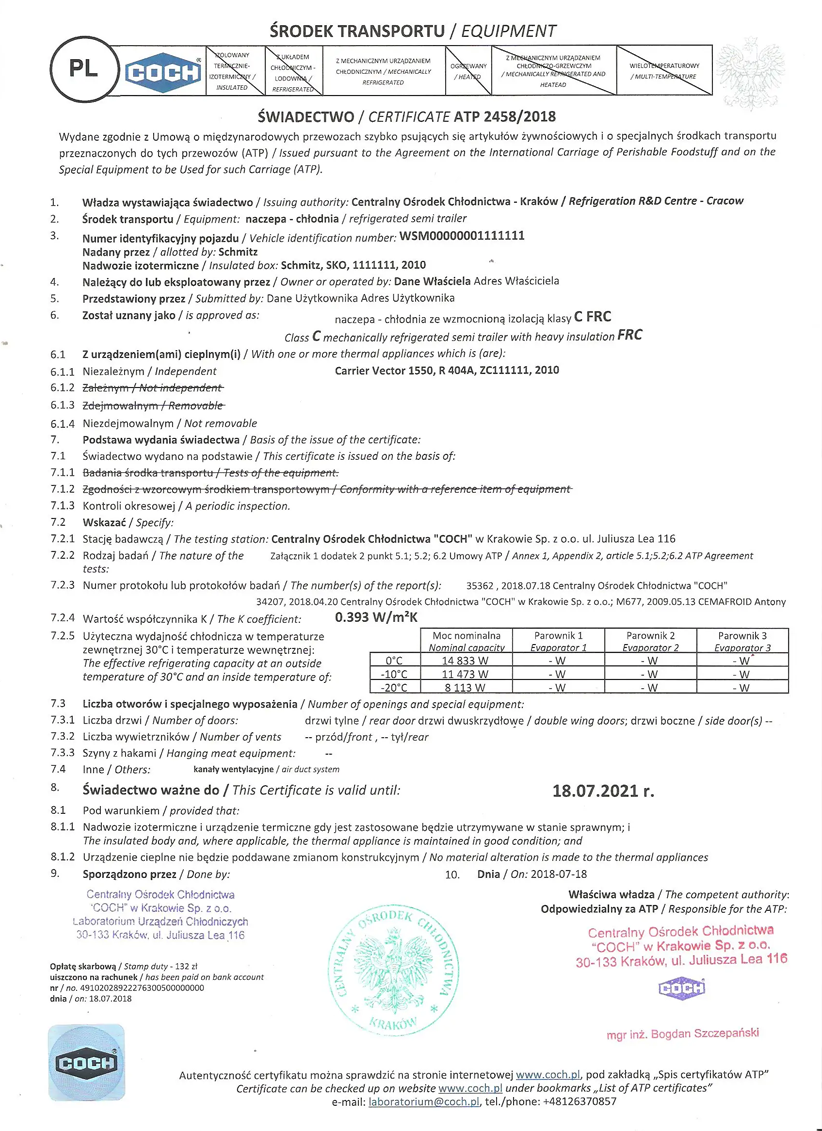
ATP Certificate
ATP certificate template

ATP Classification
Classification of means of transport

ATP mark
ATP hallmark
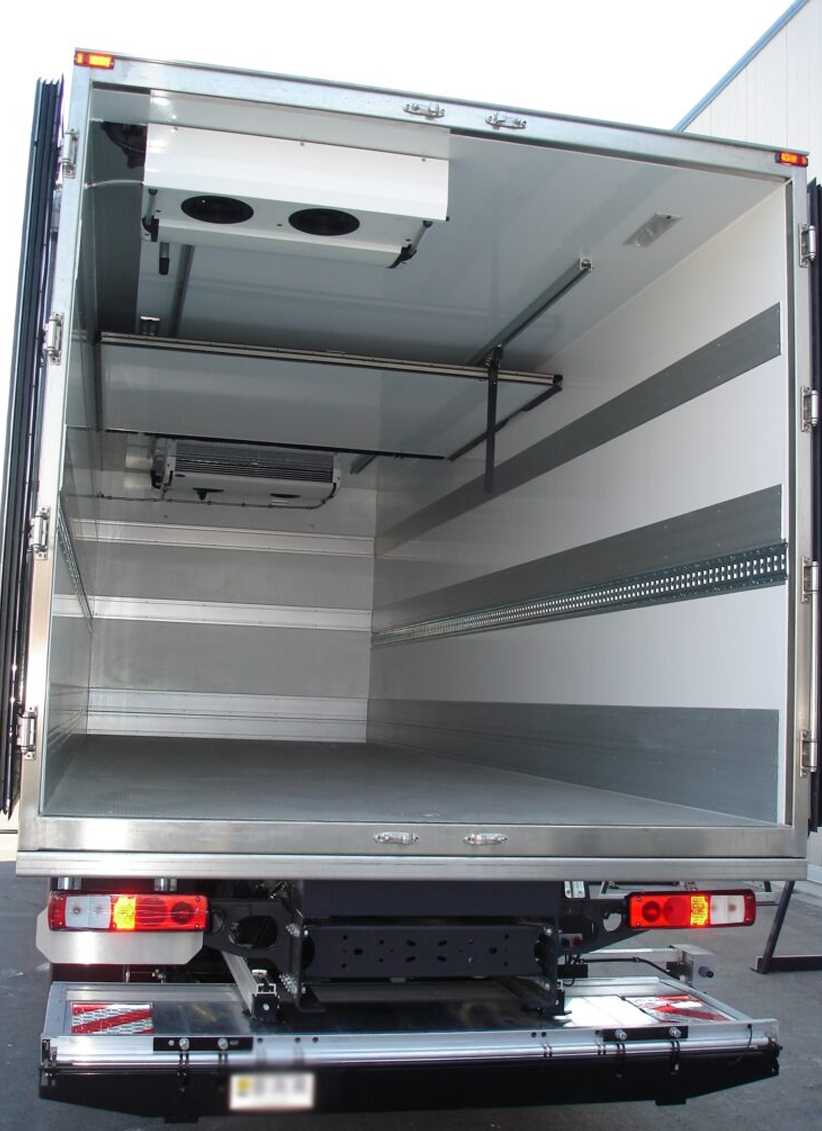
Periodic inspection
When to conduct the survey?

Food vs. ATP
Temperatures for food

Parties to the ATP Agreement
Who has ratified the ATP Convention?





Frequently Asked Questions (FAQ) - ATP
According to the ATP Agreement (Annex 1, Appendix 1, Point 1), the validity of a certificate for a new means of transport is a maximum of 6 years. For in-service means of transport (ATP Agreement, Annex 1, Appendix 1, Points 5 and 6), the maximum validity period is 3 years from the date of the test. The above-mentioned validity periods are maximum periods and may be shortened depending on the condition of the equipment. See in the Journal of Laws.
ATP refers to the International Agreement on the Carriage of Perishable Foodstuffs, on the basis of which ATP Certificates are issued. FRC or FNA refers to the classification of the means of transport indicated in the ATP Certificate. The means of transport must meet specific requirements for each class. See in the Journal of Laws.
The term 'Simplified ATP test' refers to the testing of an in-service means of transport. During the test, inspections and examinations are carried out in accordance with point 5, Appendix 2, Annex 1 of the ATP Agreement, and a temperature test of the heating/cooling unit is performed in accordance with point 6, Appendix 2, Annex 1 of the ATP Agreement. See in the Journal of Laws.
The time to issue an ATP certificate depends on the basis for its issuance (periodic inspection, simplified test, update, duplicate, compliance with a type) as well as the submission of a complete set of documents from the client and the method of document delivery.
In the case of a simplified ATP test performed at the COCH headquarters and personal collection, if all documents have been submitted, all other requirements have been met, and the invoice for the test has been paid, the certificate can be issued within 3 hours of the test completion.
For other tests and tests performed outside the COCH headquarters, this time may be extended, for example, if the documents are to be sent by courier, in which case the delivery time must be taken into account. If you want to find out when you can receive your ATP Certificate, please contact our inspectors.
A foreign certificate, i.e., a certificate issued by an authorized testing station located outside the territory of the Republic of Poland, can be re-issued for a new means of transport if it meets the requirements listed in point 3, Appendix 1, Annex 1 of the ATP Agreement. If you want to re-issue a foreign ATP certificate, please contact us.
Yes, you can reach COCH with a semi-trailer. See the map and coordinates.
Yes. However, this must be confirmed individually in each case. You can get detailed information by contacting our inspectors.
Yes. However, this must be confirmed individually in each case. Contact us to discuss the details.
If the new owner purchased a refrigerated unit with a valid ATP certificate, it is possible to update the data on the certificate to the new owner's details while maintaining the existing validity date of the certificate. If you want to update the data on your ATP certificate, please fill out the form.
Yes. According to Appendix 4, Annex 1 of the ATP Agreement, the marking with the class of the means of transport and the expiry date of the ATP certificate must be placed on the outside of the means of transport, on both sides in the upper front corners. See the application instructions available for download among the forms.
According to Point 1, Appendix 1, Annex 1 of the ATP Agreement, the original certificate should be kept inside the means of transport so that it can be presented to the competent authority during an inspection.
An ATP certificate confirms that the means of transport complies with the requirements of the ATP Agreement and can be issued on the basis of:
- Periodic inspection (ATP test) - Order a simplified test
- Test of the means of transport (determination of the 'K' coefficient) - Order a 'K' test
- Conformity with a type-approved means of transport.
Contact us, and we will issue a duplicate.
ATP markings include both the ATP plate and distinguishing marks (stickers), which contain information about the vehicle class and the certificate's expiry date. See templates and detailed descriptions.
You can do this using our online search tool. Go to the ATP certificate search tool.
The certificate should be issued in the language of the issuing country and in English, French, or Russian.
The markings indicate the temperature class of the means of transport, considering its insulation properties and the performance and operating range of the installed refrigeration/heating unit, e.g.:
- IR – Insulated equipment without a refrigeration unit.
- FNA – Normally insulated refrigerated equipment with a refrigeration unit capacity that maintains a temperature between +0°C and +12°C.
- FRC – Heavily insulated refrigerated equipment with a refrigeration unit capacity that maintains a temperature between -20°C and +12°C.
Yes, the ATP certificate is a required document for the international transport of perishable goods. Failure to present the certificate during an inspection can result in a fine, detention of the means of transport, and even the return (rejection) of the goods.
The list of competent authorities and authorized ATP testing stations in each country can be found at: https://unece.org/transport/...
If the technical condition is inadequate (e.g., damaged insulation, faulty refrigeration unit), the means of transport may not meet the requirements of the ATP Agreement. In such a situation, after rectifying the detected non-conformity, the test can be repeated. If in doubt, please contact us.
Yes. According to Appendix 1, Annex 2 of the ATP Agreement, the instruments must be verified in accordance with standard EN 13486 at least once a year. You can have your thermograph checked at COCH - fill out the order form.
If you have any doubts before purchasing a vehicle, please contact our inspectors, who will be happy to provide information.
Before buying, ask the dealer if the insulation supplier has a valid ATP type-approval for the model, if the refrigeration unit has adequate capacity, and if the dealer will ensure the issuance of a certificate for the class you are interested in. If in doubt, contact us.
This certificate is not required in Poland, but it may be different in other countries. Before starting international transport, you should check the regulations of the respective country. It is also worth remembering that an ATP certificate is often required by insurance companies, regardless of the vehicle's GVW.
Medicines and pharmaceutical products are not covered by the ATP Agreement, but many pharmaceutical companies require their products to be transported in vehicles with an ATP certificate. Additionally, GDP certification may be required for the transport of medicines and pharmaceutical products. You can find more information on GDP at the following links: Good Distribution Practice (GDP) and GDP/DPD Mapping.
FAQ FOR MANUFACTURERS OF INSULATED BODIES
Preliminary information regarding ATP testing for newly manufactured bodies; detailed information can be found in the ATP Agreement, the text of which is available at the following addresses
- in Polish: https://isap.sejm.gov.pl/isap.nsf/DocDetails.xsp?id=WDU20220001824
- in English, French, and Russian: https://unece.org/transport/road-transport/text-and-status-agreement
In order to confirm the compliance of a manufactured insulated body (truck, van, trailer, semi-trailer, container, or tank), knowledge of the heat transfer coefficient value, the so-called K coefficient, is required. The value of this parameter can be determined by performing a test at an authorized ATP testing station.
The ATP Agreement provides for two insulation classes:
- IR, when the K coefficient is equal to or less than 0.40 W/(m2K) - for heavily insulated equipment
- IN, when the K coefficient is equal to or less than 0.70 W/(m2K) - for normally insulated equipment
Notes:
- If the test shows that the coefficient value exceeds 0.70 W/(m2K), then the body will not comply with the requirements of the ATP Agreement and will not obtain an ATP certificate.
- In the case of insulation class IN, it is not possible to issue an ATP certificate in a class allowing the transport of frozen food (e.g., FRC class for mechanically refrigerated equipment).
- For the transport of frozen food in accordance with the ATP Agreement, a reinforced insulation class – IR – is required, i.e., when the K coefficient is less than or equal to 0.40 W/(m2K).”
/Annex 1, Appendix 1, para 5/
“The bodies of equipment designated as 'insulated', 'refrigerated', 'mechanically refrigerated', 'heated' or 'mechanically refrigerated and heated', along with their thermal appliances, shall be affixed by the manufacturer with permanent nameplates in a clearly visible and accessible position on a part not subject to replacement in use. It shall be possible to read this nameplate without the use of tools. In the case of insulated bodies, the manufacturer's nameplate shall be affixed on the outside. The following particulars shall be inscribed legibly and indelibly on the manufacturer's nameplate:
- Country of manufacture or letters used in international road traffic;
- Name of manufacturer or company;
- Model (figures and/or letters);
- Serial number;
- Month and year of manufacture.”
The coefficient test is a basic test. Classes IN and IR confirm the insulating properties of the body; however, in order to confirm the ability of mechanically refrigerated equipment to lower/raise the temperature inside the empty body and subsequently maintain it constantly at the required level (e.g., to obtain a certificate in class FNA, FRC, etc.), a unit with appropriate capacity must be selected. The selection should be made in accordance with the guidelines of the ATP Agreement. The capacity values of the refrigeration, heating, or mechanically refrigerated and heated unit should also be confirmed by appropriate ATP tests. Such a test is usually commissioned by unit manufacturers; therefore, before purchasing and installing the device, it is worth checking with the manufacturer if they have a test report in accordance with the ATP Agreement. In order to confirm the correctness of the selection, calculations must also be performed in accordance with the requirements of the ATP Agreement.
Note:
In the absence of a unit test report, it is possible to obtain an ATP certificate after performing and passing additional tests with a positive result; however, this is a more time-consuming and costly process.
/ Annex 1, Appendix 1, para 6 /
“ (a) New equipment of a specific type serially produced may be approved by testing one unit of that type. If the unit tested meets the class requirements, the resulting test report shall be regarded as a Type Approval Certificate. This certificate shall expire at the end of a period of six years beginning from the date of completion of the test.
The date of expiry of the test report shall be stated in months and years.
(b) The competent authority shall take steps to verify that the production of other units is in conformity with the approved type. For this purpose it may check by testing a sample or samples drawn at random from the production series.
(c ) A unit shall not be regarded as being of the same type as the unit tested unless it satisfies the following minimum conditions:
- (i) in the case of insulated units, the reference equipment may be insulated, refrigerated, mechanically refrigerated, or heated equipment, provided that:
- the construction is comparable and, in particular, the insulating material and the method of insulation are identical;
- the thickness of the insulating material is not less than that of the reference equipment;
- the interior fittings are identical or simplified;
- the number of doors and the number of hatches or other openings is the same or less; and
- the inside surface area of the body is not as much as 20% greater or smaller.
- slight and limited modifications of added or exchanged interior and exterior fittings may be permitted:
- if the equivalent volume of accumulated insulation material of all such modifications is less than 1/100th of the total volume of the insulating material in the insulated unit;
- if the K coefficient of the tested reference equipment, corrected by a calculation of the added thermal losses, is less than or equal to the K coefficient limit for the category of the equipment; and
- if such modifications of interior fittings are carried out using the same technique, particularly as concerns glued fittings.
/ Annex 1, Appendix 1, para 3 /
“In the case of equipment transferred to another country which is a Contracting Party to the ATP Agreement, it shall be accompanied by the following documents so that the competent authority of the country in which the equipment is to be registered or recorded can issue a certificate of compliance:
- (a) in all cases, the test report of the equipment itself or, in the case of serially produced equipment, of the reference equipment;
- (b) in all cases, the certificate of compliance issued by the competent authority of the country of manufacture or, for equipment in service, the competent authority of the country of registration. This certificate will be treated, if necessary, as a provisional certificate valid for a maximum period of six months;
- (c) in the case of serially produced equipment, the technical specification of the equipment to be certified as issued by the manufacturer of the equipment or his duly accredited representative (this specification shall cover the same items as the descriptive pages concerning the equipment which appear in the test report and shall be drawn up in at least one of the three official languages).
In the case of equipment transferred after it has been put into service, it may be subject to a visual inspection to confirm its identity before the competent authority of the country where it is to be registered or recorded issues a certificate of compliance.”
In this case, a so-called periodic inspection is performed. It is carried out, among other things, when the 6-year validity period of the certificate issued for a new body has expired, when a refrigeration unit in service (“used”) has been selected for a new body, or when the certificate validity period for a body in service for a longer time has expired.
In such cases, knowledge of the heat transfer coefficient "K" value is also necessary.
The periodic inspection aims to confirm the technical condition and allows determining whether the equipment still meets the requirements of the previously assigned class - if it does, the validity of the ATP certificate may be extended.
If the equipment does not meet the requirements (when, e.g., due to the age of the body, condition of the body, etc., there is a suspicion of deterioration of insulating properties), it may be sent for re-testing to check its insulating properties (determination of the "K" coefficient for the body after years of service).
Based on the determined "K" coefficient value after years of service, the existing insulation class may be confirmed, and the vehicle will obtain an ATP certificate as before; otherwise, a lower class may be assigned to the equipment, and in a situation where the heat transfer coefficient exceeds 0.70 W/(m2K), it will not be possible to obtain a certificate of compliance with the ATP Agreement.”
It is required that equipment intended for the transport of frozen products (reinforced insulation IR, equipment class e.g., FRC) be fitted with appropriate temperature recorders meeting the requirements.
/ Annex 2, Appendix 1 /
Transport equipment shall be fitted with an instrument capable of measuring and recording air temperatures and storing the data obtained (hereinafter referred to as the instrument) to monitor the air temperatures to which quick-frozen foodstuffs intended for human consumption are subjected.
The instrument shall be verified in accordance with EN 13486 by an accredited body and the documentation shall be available for the approval of ATP competent authorities.
The instrument must comply with the EN 12830 standard.
Temperature recorders complying with EN 12830 may continue to be used.
Temperature recordings obtained in this manner must be dated and stored by the operator for at least one year or longer, depending on the nature of the food.
We cordially invite you to familiarize yourself with our GDP testing and certification offer.
https://www.coch.pl/dobra-praktyka-dystrybucyjna-gdp/
https://www.coch.pl/mapowanie-gdp-dpd/
Detailed information can be found in the text of the ATP Agreement.
To clarify any doubts or in case of questions, please contact us.
Accreditation
Quality accreditation - a guarantee of trust
The AB 308 Refrigeration Equipment Laboratory is accredited by the Polish Accreditation Center and specializes in testing refrigeration equipment.
Our team consists of qualified and experienced specialists who offer comprehensive assistance in the process of preparation for testing and the testing of refrigeration equipment itself. With our services, we provide customers with reliable and professional service at every stage of cooperation.


Contact information for ATP inspectors
Below you will find a directory of contact information for COCH Laboratory and ATP Inspectors.
General Affairs
General Affairs
+48 12 637 08 57
+48 667 600 635
laboratorium@coch.pl
+48 503 021 131
+48 502 334 462
+48 786 202 626
+48 661 773 369
+ 48 786 202 630